
To store a kayak well, keep it off the ground, out of direct sun, dry and away from extreme temperatures. A garage usually covers the sun and weather, but you still need to lift the boat off the floor. If you have no room indoors, you can store a kayak outside with a cover and some planning.
Here is how to choose a spot, position the boat and get it ready to sit for a while.
The basics of kayak storage
Vibe Kayaks lists temperature, moisture, sunlight and security as the things to watch. It also advises against storing a kayak on the floor or ground. Together, that gives you five habits:
- Keep it off the ground. Pressure on one part of the hull can cause deformation.
- Keep it out of direct sun. Shade or a cover protects the boat, and it also keeps the hull cooler.
- Avoid extreme temperatures. Vibe says extreme heat can deform a kayak, and extreme cold can degrade or crack the hull. A hot summer garage or an unheated shed is worth thinking about.
- Keep it dry. Let the boat and gear dry before you put them away.
- Keep it secure. This matters most outdoors, or in any shared space.
How to store a kayak in a garage
Paddle Boston says boats are best stored indoors, away from sunlight and weather, and suggests a boat stand, foam blocks or a wall hanging system to keep the boat off the floor. A garage works well as long as the boat is off the concrete and clear of car doors.
Measure before you buy anything. Note the length of your kayak, the wall or floor space you can give up, and your ceiling height. Check the path to the door too, because you still need to carry the boat out.
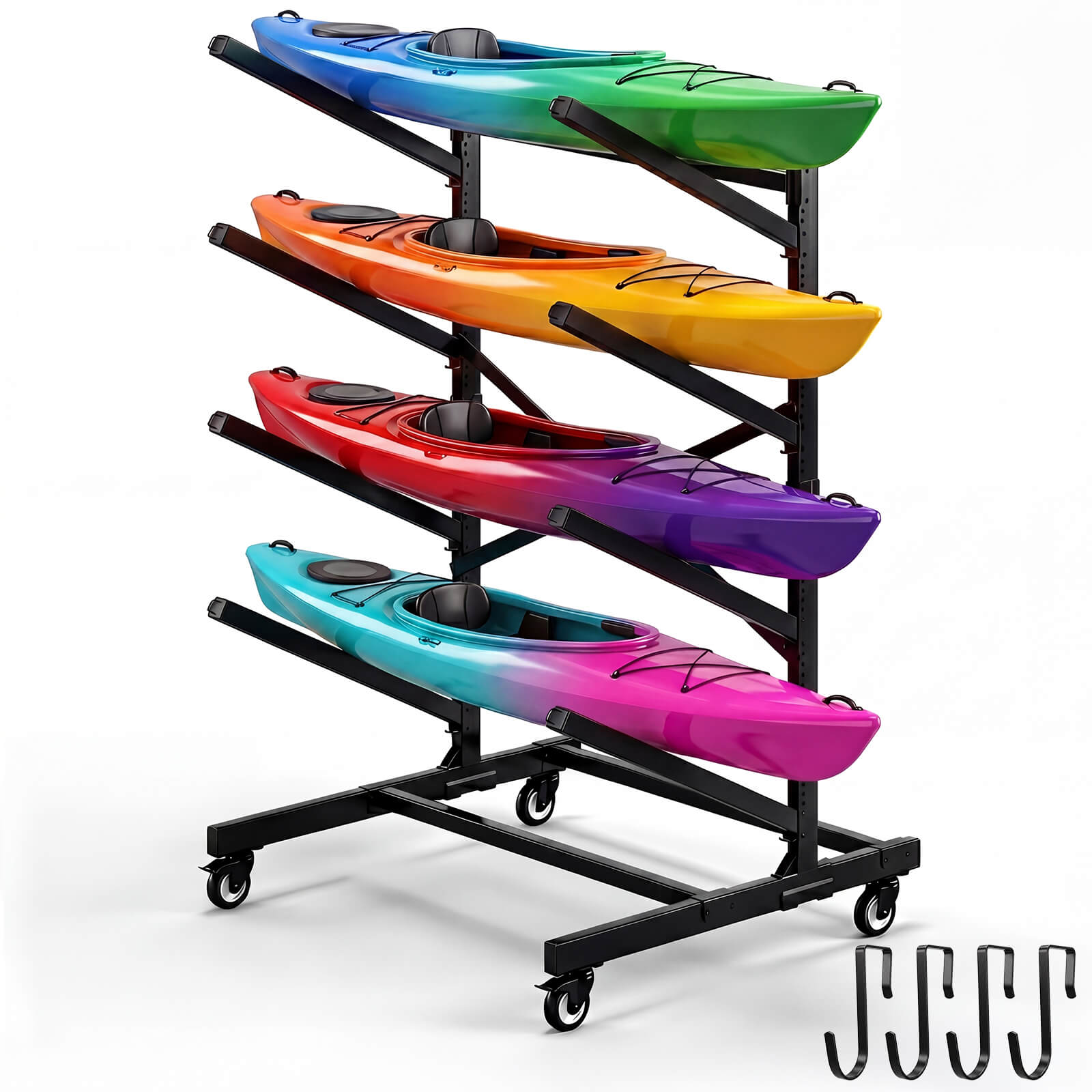
Kayak storage ideas: four common options
| Option | Works well for | Keep in mind |
|---|---|---|
| Foam blocks or a low stand | One boat, simple setup | Uses floor space |
| Ceiling suspension | Saving floor space | Needs solid mounting points, and you have to lift the boat |
| Wall-mounted rack | A strong wall with space to spare | Fixed in one place; needs solid mounting |
| Freestanding rack | Spaces where you cannot drill | Takes up floor space |
Not sure about the last two? Our freestanding kayak rack guide compares them in more detail.
How to position the kayak
Paddle Boston says plastic kayaks are best stored on their edge where possible, to minimize hull deformation. They can also go on the deck (upside down) if they are properly supported under both bulkheads. Canoes should be stored upside down, resting on their gunwales.
Vibe gives similar advice for racks: look for one that lets you store the kayak on its side, or that gives pressure relief if you store it hull side up. Your manufacturer may have its own guidance, especially for composite boats, so check the manual first. Whatever position you use, look at the hull from time to time and shift the boat if you see pressure marks.
How to store a kayak outside
Paddle Boston recommends a boat cover outdoors, on a boat that is already dry, and a cockpit cover to keep wildlife out. If you leave the boat uncovered, it suggests a full UV protectant treatment at least every two weeks. Otherwise, it suggests treating your boat and gear several times a season.
A few more steps help:
- Keep the boat in the shade, such as under an awning or roof eaves.
- If you use a tarp, keep it high or tight enough that it will not sag under rain or snow, which can deform the hull.
- Lift the boat off the ground rather than leaving it on soil or grass.
- Use a bike lock or cable lock, looped through the seat or another opening. Vibe notes that this is more of a deterrent, because straps and webbing can be cut.
- Plan for wind. A tall rack loaded with boats can catch the wind and tip, so choose a sheltered spot, lock the wheels and strap the boats down. Straps are not included with our racks, so plan to add your own. Before strong winds, take the boats down or move the rack under cover.
Before you put it away
- Rinse the boat and let it dry fully.
- Remove hatch covers if you can, which Paddle Boston says helps them keep a tight seal.
- Dry your gear, and break down two-piece paddles so they do not seize.
Where a Homstora rack fits
Our kayak storage racks are freestanding steel racks with wheels, so they need no wall mounting. Each product page lists the places that model suits. Here are the four sizes:
| Rack | Holds | Total capacity | Limit per boat | Size (L × W × H) |
|---|---|---|---|---|
| 2-tier single-sided | 2 | 200 lbs | 100 lbs | 36.6" × 46.5" × 48.8" |
| 2-tier double-sided | 4 | 300 lbs | 75 lbs | 60.2" × 46.5" × 48.8" |
| 4-tier single-sided | 4 | 400 lbs | 100 lbs | 36.6" × 46.5" × 83.9" |
| 4-tier double-sided | Up to 8 | 600 lbs | 75 lbs | 60.2" × 46.5" × 83.9" |
The limit per boat is the total capacity divided by the number of boats. Keep the average weight per boat within it. L runs side to side between the uprights, in the same direction as the boats, which will usually stick out past it. W runs front to back along the arms. H is the height.
Set each kayak hull down across the arms, as shown on the product pages. This differs from the on-edge position above, so it helps to protect the hull: the arms are metal and have no padding, so add foam between the arms and the hull to spread the pressure, especially for long-term storage. Our product images show kayaks on the racks and also list canoes and paddleboards as suitable. Set these across the arms in the same way, pad them, and keep each one within the limit per boat. A rack also does not shade the boat, so outdoors you still need a cover. With the hull down and no cover, rain can also collect in the cockpit. Because the racks have wheels, keep them locked and secure both the boats and the rack if they are within easy reach of others.