
How long you can store a 5 gallon water jug depends mostly on who filled it. A sealed jug of commercially bottled water can be kept until the date on the label, and often longer if it stays sealed and cool. Water you fill yourself, at home or at a refill station, should be replaced every six months. In both cases, where you keep the jugs matters as much as how long.
Here is what the official guidance says, how to store full jugs, and how many to keep on hand.
The short answer
| Type of jug | How long to keep it | Source |
|---|---|---|
| Sealed, commercially bottled (delivery or store-bought) | Follow the date on the jug. The FDA does not require an expiration date, and the bottled water industry says unopened water has no fixed shelf life when stored properly. | CDC, IBWA |
| Filled by you (tap, refill station, water vending machine) | Replace the water every 6 months | CDC, Ready.gov |
| Opened, or on a dispenser | No official shelf life. It is no longer sealed, so use it rather than store it. | — |
Commercially bottled jugs
The CDC calls unopened, commercially bottled water "the safest and most reliable source of water in an emergency," and says to observe the expiration date for store-bought water.
Not every jug has one. The International Bottled Water Association (IBWA), the industry's trade group, says the FDA does not require an expiration date for bottled water, and that some companies print date-based lot codes instead. IBWA's position is that there is no limit to the shelf life of properly stored bottled water. Keep in mind that this comes from the industry, not from a health agency. If your jug has a date, go by the date.
A jug from a delivery service usually counts as commercially bottled, as long as the cap is sealed when it arrives. Check the label for a date or lot code when it comes in.
Jugs you fill yourself
Both the CDC and Ready.gov say the same thing: water that has not been commercially bottled should be replaced every six months. That includes jugs you fill at a grocery store refill station or a water vending machine. Once you fill the jug, you are the one bottling it.
The container matters too. The CDC recommends FDA-approved, food-grade water storage containers, and warns against any container that once held toxic chemicals such as bleach or pesticides. Before filling a jug for storage, the CDC says to wash it with soap, rinse it, and sanitize it with a solution of 1 teaspoon of unscented liquid household chlorine bleach in 1 quart of water. Follow the CDC's full steps rather than guessing at the details.
Once a jug is opened
The guidance above is for sealed, stored water. Once a jug is opened or placed on a dispenser, it is no longer sealed, and none of these sources gives a storage time for it. Treat it as water to drink, not water to store. Keep your stored jugs sealed until you need them, and clean the dispenser as its manufacturer recommends.
Where to store 5 gallon water jugs
The CDC gives three conditions for stored water containers:
- A cool place, between 50°F and 70°F.
- Out of direct sunlight.
- Away from toxic substances, such as gasoline or pesticides.
IBWA adds a reason for the last one. Plastic bottles are slightly permeable, so vapors from things like paint thinner or gasoline can affect the taste of the water over time.
That makes many garages a poor fit. They are often hot in summer, and they are where people keep fuel, paint and lawn chemicals. A basement, pantry, utility room or an interior closet is usually closer to what the CDC describes. If the garage is your only option, keep the jugs on the coolest wall, away from the car and the chemical shelf, and out of any sun from the windows.
Keep track of the dates
The six-month rule only works if you know when each jug was filled. A few habits help:
- Label each jug with the date you filled or bought it. A strip of masking tape and a marker is enough.
- Use the oldest jug first. When you bring new jugs in, put them behind or below the older ones.
- Set a reminder for six months out if you fill your own.
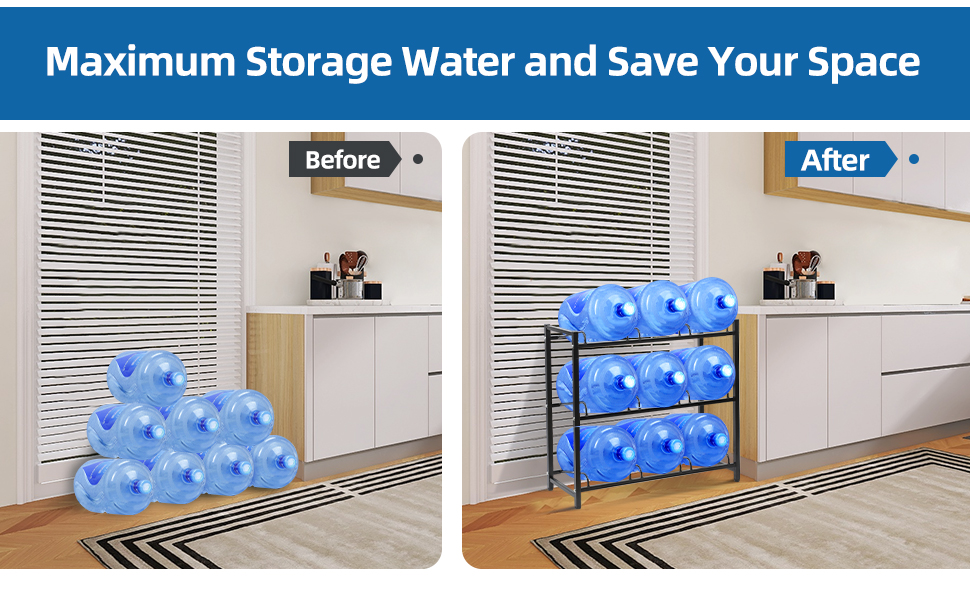
- Keep the jugs where you can see the labels. A stack on the floor hides the bottom jugs. A rack that holds each jug separately lets you read every label and pull out any jug without moving the others.
How many jugs to store
The CDC recommends at least 1 gallon of water per person, per day, for 3 days, and a 2-week supply if possible. It suggests storing more for pregnant women, people who are sick, pets, or if you live in a hot climate.
One 5 gallon jug covers one person for about five days at that rate. Here is the math for a few household sizes:
| People | 3 days | 2 weeks |
|---|---|---|
| 1 | 3 gallons (1 jug) | 14 gallons (3 jugs) |
| 2 | 6 gallons (2 jugs) | 28 gallons (6 jugs) |
| 4 | 12 gallons (3 jugs) | 56 gallons (12 jugs) |
These are minimums for drinking and basic needs. Add jugs for pets or hot weather.
A full 5 gallon jug weighs a little over 40 pounds, so a two-week supply for a family is heavy. Check the weight rating of whatever you store it on. Our 3-tier rack, for example, holds 9 jugs and is rated for 380 lbs. See all sizes in our 5 gallon water jug racks.
Quick checklist
- Sealed, store-bought or delivered: follow the date on the jug.
- Filled yourself: clean and sanitize the jug first, then replace the water every 6 months.
- Store at 50°F to 70°F, out of the sun, away from fuel and chemicals.
- Label each jug with a date and use the oldest first.
- Keep at least 1 gallon per person per day for 3 days, and aim for 2 weeks.