
A freestanding kayak rack holds your boats on its own frame, with no drilling into walls or ceilings. That makes it a practical choice if you rent or want to move your storage around. The trade-off is that it takes up floor space.
This guide covers how it compares with a wall-mounted rack and what to check before you buy.
Freestanding vs wall-mounted kayak racks
Vibe Kayaks notes that racks vary widely: some bolt to a wall, some are freestanding, others have wheels, and some hold several boats while others hold one. So check the actual product, not just the type.
| Freestanding rack | Wall-mounted rack | |
|---|---|---|
| Installation | Assembled on the floor; no drilling | Needs a strong wall and solid mounting |
| Floor space | Takes up floor space | Usually leaves more of the floor clear |
| Moving it | Can be moved, especially with wheels | Fixed once installed, at a set height |
| Rented space | Nothing to patch when you leave | Check whether you can drill |
| Stability | Relies on its own frame; check the floor and wind | Relies on the wall and the mounting |
Neither one is better in every case. If you have a strong wall with room to spare, a wall rack may be all you need. If you cannot drill, or you want to be able to move the rack, a freestanding rack is usually easier.
What to check before you buy
Number of boats. Count what you own now, and any boats you may add. Remember paddleboards or canoes if they need a spot too.
Weight capacity. Add up what you plan to store, including anything left on the boats, and water if a boat is still wet. Check your kayak manual if you are not sure of the weight. Compare the total with the capacity of the whole rack, and with the limit per boat in the table below.
Footprint. Measure the floor space, and allow room for the boats themselves, which can stick out past the frame on both ends. Leave enough space to walk around and to lift boats on and off.
Height. Measure your ceiling, as well as anything overhead such as a garage door track or lights. A taller rack holds more, but you have to lift boats higher to reach the top tier.
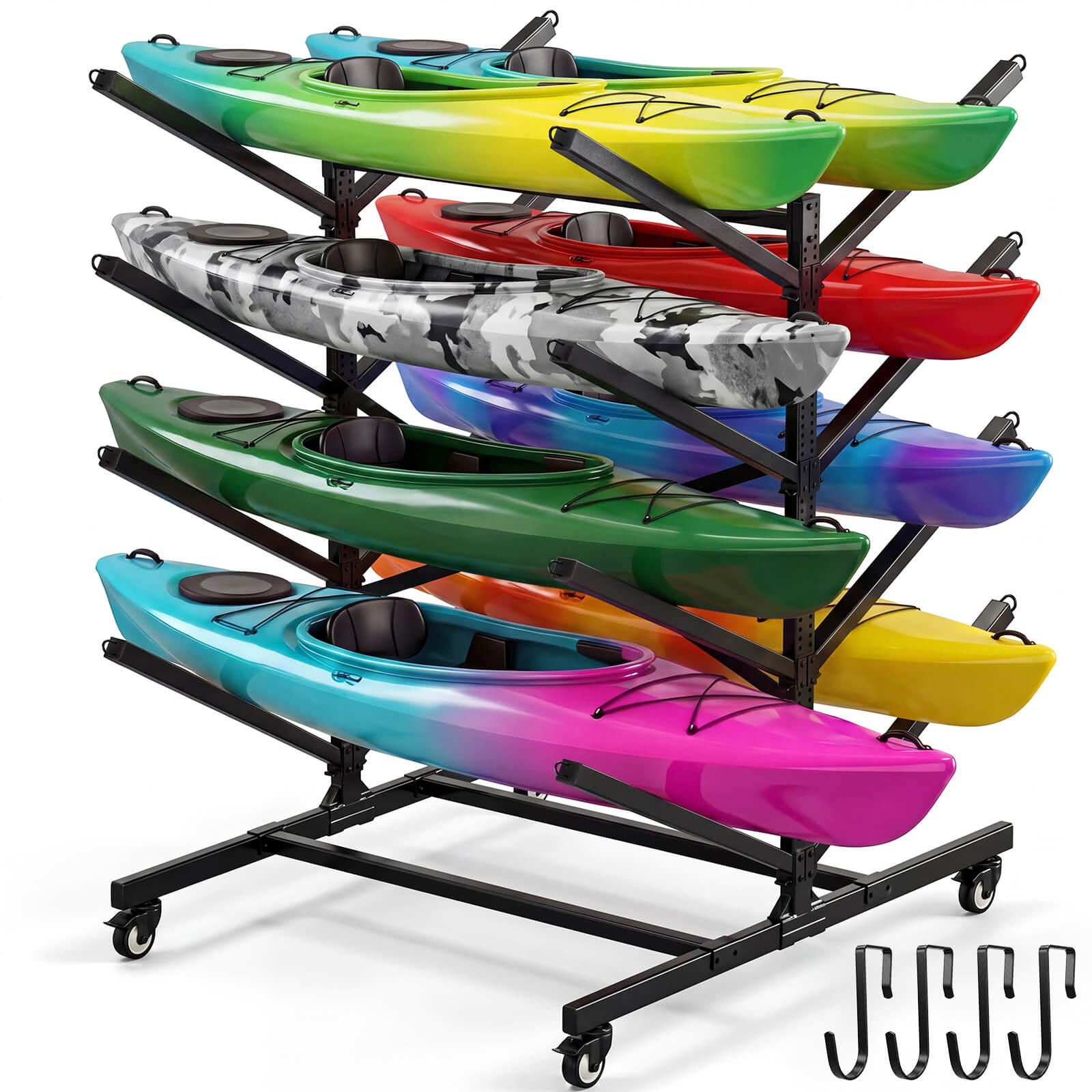
Single-sided or double-sided. A single-sided rack holds boats on one side, which suits a spot along a wall. A double-sided rack holds boats on both sides, so it stores more but needs access from both sides.
Wheels. Wheels let you move the rack to clean or rearrange, and locks hold it still while you load. Check that the floor is firm and level enough to roll on.
Adjustable arms. Hull shapes vary, so adjustable arms make it easier to fit different boats.
Extras and assembly. Our racks come with S-hooks for paddles and other gear, and take two adults about 15 to 20 minutes to assemble, depending on the model.
Using a freestanding rack safely
- Lock the wheels before you load or unload a boat.
- Get a second person to help with heavy boats and the higher tiers.
- Stay within the listed capacity, and follow the assembly manual.
- Put heavier boats on the lower tiers, so you are not lifting them as high.
- You can roll the rack with boats on it. Go slowly on a firm, level floor, then lock the wheels again.
- Outdoors, plan for wind. A tall rack loaded with boats can catch the wind and tip, so choose a sheltered spot, lock the wheels and strap the boats down. Straps are not included with our racks, so plan to add your own. Before strong winds, take the boats down or move the rack under cover.
Which Homstora rack fits
Our kayak storage racks are steel racks with wheels and adjustable metal arms. Here are the four sizes:
| Rack | Holds | Total capacity | Limit per boat | Size (L × W × H) |
|---|---|---|---|---|
| 2-tier single-sided | 2 | 200 lbs | 100 lbs | 36.6" × 46.5" × 48.8" |
| 2-tier double-sided | 4 | 300 lbs | 75 lbs | 60.2" × 46.5" × 48.8" |
| 4-tier single-sided | 4 | 400 lbs | 100 lbs | 36.6" × 46.5" × 83.9" |
| 4-tier double-sided | Up to 8 | 600 lbs | 75 lbs | 60.2" × 46.5" × 83.9" |
L runs side to side between the uprights, in the same direction as the boats, which will usually stick out past it. W runs front to back along the arms. H is the height.
The limit per boat is the total capacity divided by the number of boats. Keep the average weight per boat within it. Weigh this up if you have a heavy boat, such as a fishing kayak, and contact us if you are not sure.
| If you have | Consider | Why |
|---|---|---|
| 1–2 boats, tight space | 2-tier single-sided | The smallest footprint and the lowest height |
| 3–4 boats, low ceiling or easy loading | 2-tier double-sided | A lower height, so no tier is far to lift, but it needs access from both sides |
| 3–4 boats, along a wall | 4-tier single-sided | Loads from one side on the same footprint as the 2-tier, but you lift higher |
| 5–8 boats | 4-tier double-sided | The most boats, but it is tall and needs access from both sides |
Set each kayak hull down across the arms, as shown on the product pages. The arms have no padding, so add foam between the arms and the hull. Our product images show kayaks on the racks and also list canoes and paddleboards as suitable. Set these across the arms in the same way, pad them, and keep each one within the limit per boat. For tips on positioning and care, read how to store a kayak.